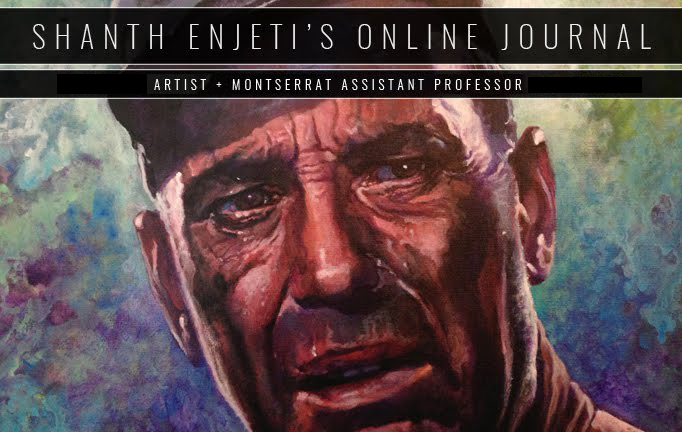
Here's an image I'm using as a warm-up before I start any technique-heavy work. My approach to this image mirrors a technique I use on my black and white sequential work. This work is done on a
Canson bristol-like paper that they use in their comic art line of paper. The paper was originally developed in Turkey and handles a variety of media exceptionally well. It also has the unique ability to be run through my old
Epson Stylus 1280 printer which is essentially the same as
this printer.
For this work, I scanned in
the ancient photocopies of some of my college work, printed them in a very light grey on the
Canson paper, and now I have a pristine surface that is ready to be inked and have additional pencilling done on it if need be. If this was a comic page, I would be doing the same process with my rough layouts being enlarged and printed instead.
Following this part of the process, I use
Faber-Castell PITT artist pens. I tend to use the range of grey brush-tips that they make, starting with WarmGrey III 272 and then Cold Grey 232, and a dark grey (235). I use the black brush-tip as well as the black size XS pen tip (the smallest size). The panel borders are done with a black size S pen tip.
What make these pens so extraordinary is the fact that the PITT artist pen's ink is waterproof and does not bleed or smear when I lay washes of opaque watercolors over my ink lines. The pens also allow for the paint to absorb into the paper under the ink, which waterproof India Ink resists. If I want to add additional lines (and I always do) over the washes once they've dried, the pens do this with ease. I always use a blowdryer between washes for technical work to speed up the drying process.
I also use that same tube of white to hatch into darker areas and line with white using a small round-tip watercolor brush size 0.
The image above is on a 9 inch by 12 inch sheet of the Canson paper.